Road to Publication is a column by authors, agents, publishers and publicists who will discuss the journey from finishing your manuscript to selling your book.
Elizabeth Harlan’s Journey with Young Adult Fiction
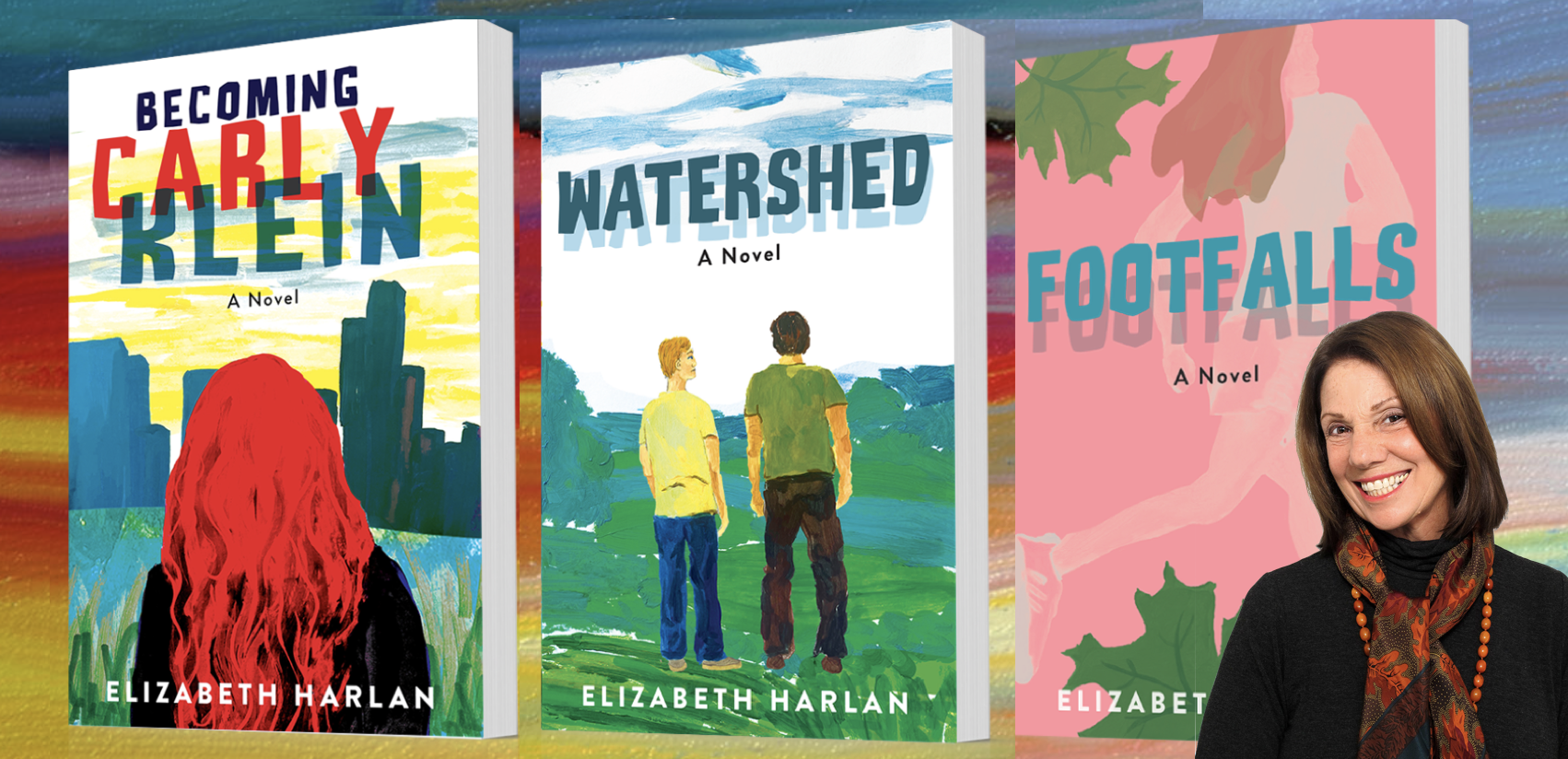
July 16, 2026. Elizabeth Harlan ('67BC, '87SOA), recently published her third YA novel, Becoming Carly Klein (2024) with SparkPress, a hybrid publisher distributed by Simon & Schuster. The book, which chronicles the reckless decisions of a teenage girl living in New York in the 1980s, was selected the 2025 International Book Awards Winner in Young Adult Fiction. It was also a finalist for the National Indie Excellence Awards, and a 2024 Semifinalist for the BookLife Prize in Fiction.
Her previous books, Footfalls (Atheneum 1982) and Watershed (Viking 1986), and her forthcoming novel, Code Name Courage (She Writes Press 2028), are all Young Adult fiction. Elizabeth is also the author of a biography of George Sand (Yale University Press 2005).
Asked why she chooses to write about teenage protagonists, Harlan replied, "My feeling is that the adolescent experience is essential to who we are and who we become. There's a lack of filters, inhibition, and convention. When I examine the experiences that are key to my own development, they often lead back to my adolescence, a time when the world was new to me and my impressions were in the process of formation."
YA books appeal to more than adolescent readers, however. “Older readers enjoy reading YA because it’s reminiscent of experiences that formed who they have become today. If the material in a YA book is good—if it’s true, if it’s essential—it will resonate. Even as we grow older and more mature, what doesn’t change is the fact that we all came of age with impressive and indelible experiences because they were fresh and new.”
“I never intended to write for the Young Adult market,” Harlan explained. “The books I read as a younger person were just books. They were literature.” And that’s what she set out to write when she wrote her first novels: “Just literature.”
Footfalls, published in 1982, benefited from a surge in interest in the YA genre. The publishing industry “was craving teen-centered material, and so with Footfalls, I made one phone call and got an agent,” Harlan recounted. “The book sold in a week or two. We had multiple offers. It was a very good book, but it would not be a book that would be grabbed that way today.”
Harlan went on to explain: “The publishing landscape is far more crowded and competitive, and agents are interested, as they should be, in building literary careers for the authors they represent. As a much older writer now—I turned 80 this past November—I accept that I'm a less favorable candidate for representation than a younger writer with a longer lease on life and literary production.”
Without representation—Harlan's previous literary agents have retired—she is thrilled that her fourth novel, Code Name Courage, will come out at the top of 2028 with the award-winning hybrid publisher, She Writes Press.
"Like most writers, in my fondest dreams, my books would be best-sellers," Harlan admitted. "And I'm not pretending it doesn't matter, but I'm saying being a best-seller is not my goal. My goal has always been to write, to get published, and to be read. And my real reward has been the positive response—favorable reader reaction, good reviews, and literary prizes—that I've received."
Harlan in a recent profile in the Barnard Bulletin (April 2025) discussed how Barnard College, Columbia University, and New York City helped shape Carly, a coming-of-age novel, where the campus is described as “almost like a magical kingdom in a storybook.”
Harlan is starting her fifth book project, an historical fiction about a mother and daughter who sat for John Singer Sargent, the American portrait artist. She said that finding new subjects is exciting. “At my age, there is still more that I want to say, that I still feel the ability to say. Writing is something you can do forever if you have your mind, which is a great gift as we age and something we shouldn’t take for granted.”
As a new member of CFF, Harlan said, “I’m delighted that it’s open to anybody who went to any of the Columbia University affiliated schools. The broader the base, the more interesting, diverse, and valuable the interplay among members becomes.”
Harlan’s website: https://elizabethharlan.com/